TEXTILE CHEMISTRY

This blog is for information of various textile chemistry as well as processing subjects, like, Bleaching, Dyeing, Printing, Finishing, Quality control, Process control ,Textile processing machineries, Management of Textile Industries, Computer application, Technical Textile, New trends in textile processing, etc...

Hope you will find your requirements here..... !

Any Query about Textile Chemistry is warmly WELCOME... !

Saturday, 26 February 2022

Properties of DIRECT DYE


Properties of DIRECT DYE

MECHANISM

  • Hydrogen Bonding.
  • Vander Waal’s Forces between Fiber Surface and Dye Molecule.
  • Larger Molecule Size.

SOLUBILITY

  • Soluble in Water.
  • Good Affinity.
  • Polar Nature.

CHARGEABILITY

  • Carry Negative Charge.
  • Discharge by Adding Salts,

i.e. Na2SO, CuSO3

SUBSTANTIVITY

  • Moderate Substantivity for the Fiber because of Larger Size of Molecule.
  • pH Range: 10 - 11

FASTNESS PROPERTIES

  • Washing        :   Weak  
  • Rubbing        :    Poor
  • Lightening    :    Good
  • Chemical       :    Poor
  • Perspiration  :    Average

APPLIANCES

  • They are Applicable on Cellulosic and Proteinic  Fibers;

i.e. Viscose, Silk.

COLOUR RANGE

  • Large Range of Colors.
  • Dull and Darker Shades.
  • All Colors are Achievable.

ENVIRONMENT BEHAVIOUR

  • Non-Environmental Friendly.
  • Carcinogenic Dye.

Saturday, 8 January 2022

SCOURING (Fundamentals)

 Introduction

  • The loom state cotton fabric contains about 8-12% natural impurities of the total weight of the fibre.
  • These impurities mainly consist of waxes, proteins, pectic substances and mineral matters. 
  • In addition to this, the mechanically held impurities called ‘motes’ are present containing seed-coat fragments, aborted seeds and leave etc. that cling to the fibre.
  • Apart from these, the loom-state fabric is also contaminated with adventitious oils such as machine oils, tars, greases etc.
  • Scouring is a purifying treatment of textiles.
  • The objective of scouring is to reduce the number of impurities sufficiently to obtain level and reproducible results in dyeing and finishing operations.
  • Scouring agents can be generally classified into different groups.
  • The appropriate type of scouring agent generally depends on the kind of fibre; fabric type i.e. woven or knitted, thick or thin; texturised or non-texturised and the extent of impurities present in the fibre.

 Classification of textile scouring agents 

  • The selection of alkali is most important as free alkali can have a deleterious effect on certain fibres. Alkali neutralises the carboxyl group in cellulose and in pectin.
  • The hydroxyl groups on the glucose units in cellulose are also weakly acidic. Owing to this preferential sorption, the concentration of alkali in the fibre is increased and thus attacks the impurities more intensively.

Mechanism of Removal of Impurities

  • The action of an alkaline scouring agent is to saponify any residual oils, neutralise carboxylic acids, solubilise any sizing materials and cause dispersion of naturally occurring impurities in natural fibres.

               Techniques for Removing Natural Impurities of Cotton during Scouring


Meltblowing Process

  • Meltblowing is a process for producing fibrous webs or articles directly from polymers or resins using high-velocity air or another appropriate force to attenuate the filaments.
  • This one is a recent technique developed in nonwoven manufacturing.
  • The advantage of this process is its ability to produce microfiber webs having diameters ranging from 0.1 mm to 15 mm, from which diameters 2-4 mm are popular.

Raw Materials

The meltblown process has no or little orientation after extrusion. Hence many polymers apart from Polypropylene and Polyester can be processed:

1)      High-density polyethylene (HDPE), Low-density polyethylene (LDPE), LLDPE

2)      Polyamides (PA 6, PA 6.6, PA10)

3)      Polystyrene (PS)

4)      Polytrifluorochloroethene (PCTFE)

5)      Polycarbonate (PC)

6)      Polyurethane (PUR)


Meltblown Process

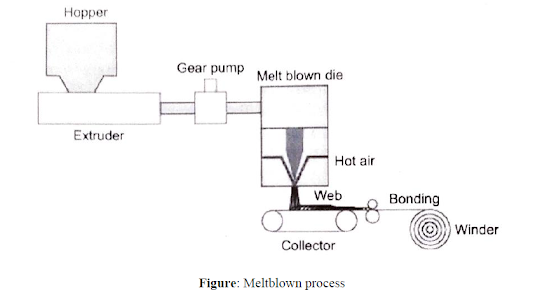
Meltblowing is a single-stage process in which high-velocity air blows a molten thermoplastics resin an extruder die tip onto a conveyor or take-up screen to form a finely fibrous and self-bonding web as below:


 The components of meltblowing process are:
  • Extruder: from the hopper feeder, the polymer chips are feds to the Archimedean screw, which rotates inside the cylinder; due to this rotation chips are forwarded to the hot walls of the cylinder, so the polymer melted by heat and frictional forces. The screw is divided into feed, transition, and metering zone.

ð  The feed zone preheats the polymer pellets.

ð  Transition zone compresses and homogenizes the melting polymers.

ð  Metering zone serves to generate maximum pressure for extrusion.

  • Metering Pump:  It controls the delivery of the melt to the die assembly ensuring a consistent flow of polymer with the required pressure, temperature, and viscosity. It is designed with two intermeshing and counter-rotating toothed gears.
  • Die Assembly:

ð  Feed Distribution: It distributes the flow evenly to all the spinnerets flow and ensures constant residence time across the width of the die in all instances. There are two types of feed distribution, one is T-type and another is coat hanger type (widely used).

ð  Air Manifolds: The die nosepiece is designed with slots through which the air manifolds supply the high-velocity hot air. Generally, the temperature of 230˚C to 360˚C and air velocities of 0.5-0.8% of the speed of sound.

ð  Die Nosepiece: The design of the die nosepiece is responsible for web uniformity. It is typically a hollow and tapered piece of metal having a linear arrangement of several hundred orifices along its width. The polymer melts extruded through these holes and the emerging filaments are quenched using hot air. The dimension of the nosepiece includes a diameter of 0.4 mm and the number of orifices per mm ranges from 1 to 4.


  • Web Formation: Extruded polymers passed through the die holes, hot air streams of high velocity, and the die nosepiece to form microfibers. The hot air stream directs the microfibers to a collecting screen. On the way to the same screen, the secondary air cools and solidifies the fibers. Due to random deposition of fibers, they entangled themselves, and hence air turbulence forms a self-bonded nonwoven web. The collector speed and the distance of the die nosepiece from the collector screen are playing major roles in producing different types of meltblowns. The hot air lying on the fibers can be withdrawn by applying a vacuum inside the collector screen.
  • Winding: The web is wound onto a cardboard core and processed according to the end-use requirement. 
  • Bonding: To improve the fiber adhesion and web characteristics, the web may be subjected to additional bonding processes like thermal bonding. Either area bonding (overall) or pattern bonding (spot) techniques can be adapted, which improves the web strength and abrasion resistance.
  • Finishing: This treatment is not mandatory, finishing treatments like calendaring, embossing can be performed at the end of the production line. 
Process Variables
  • The process variables are divided into two categories such as operational/online and offline variables.     

Web Characteristics and Properties

  • The distribution of fiber in the air stream and the vacuum settings below the collecting screen determine the web uniformity.
  • Non-uniform distribution can be caused due to poor die design and improper airflow in the air stream.
  • The vacuum under the collector should be capable of withdrawing the entire air stream through the perforations and randomly locking the fibers in place.
  • As the distance between the die and the collecting screen increases, the web uniformity decreases.

Product characteristics

ð  Random fiber orientation in the web

ð  Lower to moderate web strength

ð  High opacity

ð  Low GSM material

ð  Fiber diameter ranges from 0.5 to 30m, but typically 2-7 m

ð  Basis weight ranges from 8 – 350 g/m2, but typically 20 – 200 g/m2

ð  Good insulation and filtration characteristics

ð  Smooth and soft surface texture and are circular in cross-section

ð  Layered structure, the number of layers increases with basis weight.


Application

Medical fabrics

  • Disposable gown
  • Drape market
  • Sterilization
  • Wrap segment
  • Sanitary products etc.

Adsorbents

  • Sorbents to pick up oil from the surface of the water like, encountered in an accidental oil etc.

Filtration media

  • Filter media
  • Cartridge media
  • Cleanroom filters and others

Apparel

  • Thermal insulation
  • Disposable industrial apparel
  • Substrate for synthetic leather

Electronic specialities

  • Liner fabric in computer floppy disks
  • Battery separators
  • Insulation capacitors

Miscellaneous

  • Manufacture of tents
  • Elastomeric non-woven fabrics etc.

References

  • Karthik T., Prabha Karan C., and R. Rathinamoorthy (2016), Non-woven - Process, Structure, Properties and Applications, Woodhead Publication India, pp. 80-86.
  • Giovanni Tanchis (2008), The nonwovens, ACIMIT.
  • Lokesh K V (2013), Meltblown nonwoven, www.textilelearner.blogspot.com

Sunday, 26 December 2021

Percentage Purity of Sulphuric Acid


Process:

ð  Weigh 2 g of the sample accurately in weighing bottle.

ð  Transfer the same sample in a 500 ml. volumetric flask.

ð  Made the solution up to 500 ml. with distilled water.

ð  Pipette out 10 ml. from the same solution using volumetric pipette and transfer it into a conical flask.

ð  Add 2 – 3 drops of phenolphthalein indicator.

ð  Titrate it against 0.1(1/10)N NaOH (sodium hydroxide).


Chemical Reaction:

2NaOH(aq) + H2SO4 (aq) à Na2SO4 (aq) + 2H2O(aq)

Calculation:

            1000 ml 1 NaOH   ≡  49 g H2SO4

1000 ml 0.1 N NaOH   ≡  4.9 g H2SO4

1 ml 1 N NaOH  ≡  0.0049 g H2SO4


% PurityBurette Reading (BR) X Eq.Wt.

                                            4

 % Purity =  (BR) X 49

                           4

 % Purity =  (BR) X 12.25


Answer: % Purity of H2SO4 is (BR) X 12.25

Sunday, 12 September 2021

A Bird’s Eye View of Dyeing

           The colouration of cotton is in regular practice since the ancient era. This colouration is termed “Dyeing” which is the decorating of textile materials by applying basic principles of chemistry. So, it can also be defined as “Applied Chemistry”. Cotton must be well pretreated for achieving perfect dyeing. Well pretreated means, well desized, scour and bleach. Also, whiteness is majorly concentrated for dyeing operations. One would select full white fabric for dyeing pale shades. Dark shades application do not require full bleach fabric, so the supervisor can proceed for half bleach only.

            The textile materials are coloured with dye or pigments with desired colour fastness is termed as “Dyeing”. The said operation was performed with natural dyes prior, but nowadays natural dyes have been replaced by synthetic dyes. The first synthetic dye was discovered by Perkin in 1856. Travelling from ancient to today’s world, cotton has locked its popularity. Therefore, the dyeing of cotton is also at the same level as industrial practices. Cotton dyeing can be performed in various forms. 


Various terms related to dyeing operation are commonly used, therefore, what they mean is important to know.

Self-Shade

            When cotton, in any form, is dyed with a single dye to produce full shade, is known as “Self-Shade”.

Compound Shade

             When cotton, in any form, is dyed with a mixture of two or more dyes to produce full shade, is known as “Compound Shade”.

Solid Shade

            When the warp and weft, both yarns are of the same textile material, then the obtained shade due to dyeing is known as “Solid Shade”

Per cent Shade

            The amount of dye present on the textile material after dyeing is termed as “Percent Shade”. Thus, if 1 g of dye is utilized for 100 g of textile material, then it is said to be 1% shade. This does not suggest that the material has 1 g of dye on it for its 100 g of weight.

Per cent Exhaustion

             At the end of dyeing, the amount of the dye taken up by the textile material from the dye liquor is calculated as “Percent Exhaustion”. Thus, if a dyer wants to produce 1% shade on 200 g fabric, he required 2 g of dye which is the concentration at starting of dyeing. At the end of dyeing, if liquor contains 0.2 g of dye in it. That means 1.8 g dye has been taken up by textile, so the exhausted dye is 90%. As the exhaustion is higher, dye waste is lower.

Material to Liquor (M:L) Ratio

            The requirement of the total quantity of water depends on the weight of the textile material. On the weight of the material, the dyer takes the water. This total quantity of water on the weight of the material is known as “Material to Liquor Ratio”. If dyer is writing 1:30 M:L ratio, means 1 g of textile material requires 30 ml of water to dye it or 1 kg of the same requires 30 kg of water. A low ratio must be preferred as it reduces water consumption.

Standing Bath

              During dyeing, when the exhaustion is very low, a major amount of dye is not used and so it is wasted. Dyer utilizes the same bath again for another lot with the same shade requirement. Such stored dye baths are termed “Standing Bath”. Particularly, this type of bath is used in sulphur, indigo, and an azoic class of dyes.

Cross Dyeing

            When manufactured textile material contains different kinds of fibres, like cotton and polyester blend, then the dyeing is performed with a single bath with the mixture of dyes or with two baths by dyeing each component in a separate bath. This dyeing is termed “Cross Dyeing”.

Reserve Dyeing

            Dyeing of a blend like cotton and polyester is done by reactive dye will result in the dyeing of cotton only, and polyester will be undyed. This happens due to the affinity of reactive dye towards cotton only, not to the polyester. Thus polyester is reserved for dyeing. This operation is known as “Reserve Dyeing”.

Topping

            The dyed fabric is over-dyed with another dye of a different class or same class to obtain a deeper shade or brighter shade for generating a multicolour effect. This over-dyeing process is termed “Topping”. It helps in producing deeper shade by reducing the cost.

Tailing Effect

            The shade of dye during dyeing is weakened on some specific machines. So the shade becomes lighter than the dyed area of the material. So the dyeing results in dark and light shades. This effect is “Tailing Effect”

Stripping

            After dyeing, if the material is uneven dyed or shade is darker than required is achieved, dyestuff present on the material has to be removed completely. Removal of dyestuff is termed as “Stripping”.

Parameters of Dyeing

            Cotton dyeing is complicated chemistry compare to synthetic dyeing. As the natural fibre, cotton has many variables affecting the dyeing procedure. Generally, the dyer tries to exhaust maximum dye onto the material. Such exhaustion is affected by various parameters. Such parameters are:

  • Not in Control of Dyers
  1. Fibre Shape Factor (S):
  2. Ratio of the bimolecular rate constant (RF)
  • In Control of Dyers (Fully/Partially)
  1. Dye Dissolution: The dye must be pasted with cold water and then pouring warm water with high-speed stirring. This solution must be prepared before utilizing it in dyeing. The pH of the water should be neutral, and the water must be soft. The recommended level for the water used in dyeing.

Total Hardness

50 – 55 ppm

pH

7.0 + 0.5

Copper

0.05 mg/l

Iron

0.05 mg/l

Chloride ions

300 mg/l


  1. Exhaustion of Dye: Exhaustion (substantivity) of the dyes affected by dye structure,  concentration of the dye, temperature of the dye bath, and pH. If the dye structure is planner then the exhaustion will be high compare to the complex structure. As the exhaustion is high, migration will decrease, and uneven dyeing increases. So the substantivity between dye and fibres must be proper.
  2. Temperature: Temperature affects the dyeing process based on the class of dyes utilized for the dyeing. It depends essentially on the heat of dyeing of various dyes. An increase in the temperature will result in a low substantivity ratio and reactivity will increase which reduces the efficiency. 
  3. pH: As dyer change the pH, the substantivity of individual dye is affected. pH profile will decide the fixation which required sufficient time required for reacting the dye with fibre.  
  4. Liquor Ratio: M:L ratio is largely under the control of dyer. As the amount of liquor reduces, depth of shade, concentration of dye must increases. So the ratio of substantivity decreases.
  5. Electrolyte concentration: The rate of reaction and efficiency increases with the increase in electrolyte concentration. It also affects the reactivity of dye in little amount with precipitation or aggregation. So there must be some limit on the electrolyte concentration.

Classification of Dyes

ð According to Chemical Constitution: The colour index listed several chemical classes. A dye may have a single or multiple functional or chemical groups in its structure. They are unlimited and regularly developed by dye manufacturers. Some reported classes are:

Nitro

Diphenylmethane

Thiazole

Aminoquinone

Nitroso

Triphenylmethane

Indamine

Hydroxyketone

Monoazo

Anthraquinone

Indophenol

Indigoid

Disazo

Xanthene

Azine

Phthalocyanine

Triazo

Acridine

Oxazin

Chorotiazinyl

Polyazo

Quinolone

Sulphur

Vinyl sulphone

Stilbene

Methine

Lactone


ð According to Methods of Application: The dyes are classified into two broad categories, viz. readymade and ingrain dyes. Readymade dyes are further classified into water-soluble and insoluble categories. Ingrain dyes are developed on the surface or insitu by coupling intermediate compounds which are not true dyes. Classification is as follows:


Mechanism of Dyeing

            The dyeing mechanism deals with various theories, such as kinetic theory, molecular theory, and thermodynamic theory. These theories are utilized for explaining the physic-chemical principle involved in dyeing. So, the mechanism of dyeing is divided into four fundamentals phenomena which are:

1)      Exhaustion: Migration of dye particles from dye solution to the fibre surface.

2)      Adsorption: Dye particles are locking their position on the surface of the fibre.

3)      Absorption: Dye particles travelled/diffused to the inner structure of the fibre from its surface.

4)      Fixation: Dye attached with the fibre and permanently locked its position in the fibre.


By keeping all the above parameters in mind, dyes are selected for the dyeing based on:

1)      Compatibility

2)      Consistency

3)      Reproducibility

4)      Right first time